Personalized Medical Care & Dedicated International Patient Concierge

Medical Guide
Canthoplasty vs. Canthopexy: Eye-Shape Surgery Explained
Canthoplasty reshapes the eye corner by altering the canthal structures, while canthopexy tightens them without detaching. Here is how the two differ.
Schedule a ConsultationCanthoplasty vs. Canthopexy: Understanding Eye-Shape Modifying Procedures
Medically reviewed by Dr. Hong Sung Taek, Chief Director & Board-Certified Plastic Surgeon, Merry Plastic Surgery
Canthoplasty and canthopexy both involve the canthus, the corner where your upper and lower eyelids meet, but they are not interchangeable operations. Canthoplasty alters or reconstructs the canthal structures themselves, while canthopexy tightens and supports the tissues already in place. Merry Plastic Surgery, a clinic in Gangnam-gu, Seoul, lists canthoplasty within its Eye Surgery category and describes four separate canthoplasty approaches chosen from each patient's own anatomy. Knowing which word describes which operation helps you ask for the right thing at consultation.
What the Canthus Is and Why It Governs Eye Shape
The canthus determines much of what people perceive as eye shape, because it fixes where the eyelid margins begin and end. Cleveland Clinic describes the canthus as the corner part of the eye where the upper and lower eyelids meet, and defines canthoplasty as surgery that reshapes that corner. Each eye has two. The medial canthus sits toward the nasal bridge, and the lateral canthus sits toward the ear.
Together those points set the horizontal length of the eye opening and the angle at which the corners sit. Cleveland Clinic explains that a lateral canthoplasty reconstructs the outer canthus, while an epi-canthoplasty reconstructs the inner canthus near the nasal bridge. Because these are structural landmarks, no cream, filler, or makeup technique changes them.
What Canthoplasty Actually Does
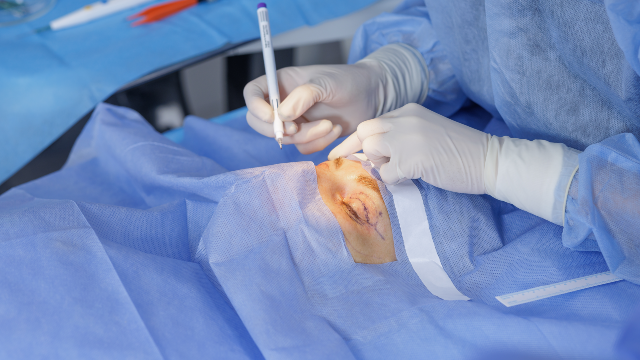
Canthoplasty modifies the corner of the eye by tightening or repositioning the tissue that anchors it. Cleveland Clinic explains that the procedure tightens the muscles, tendons, ligaments, and connective tissue of the eyelid, and lists the reasons patients pursue it: firming a sagging eyelid, correcting an eyelid tilt, evening out mismatched eyelids, altering eye shape, and widening the field of vision. Cleveland Clinic also notes that canthoplasty is sometimes called the almond eye procedure.
Merry Plastic Surgery describes canthoplasty as an incision-based eye surgery that adjusts the inner corner, the outer corner, or both, aiming to improve eye width, corner angle, openness, or symmetry. The clinic notes it may also suit patients who want a conservative change without altering the eyelid crease. That distinction matters: crease height and eye-corner shape are separate problems handled by separate operations.
What Canthopexy Is and How It Differs
Canthopexy supports the outer corner without taking the canthal anchor apart. Cleveland Clinic describes canthopexy as surgery that tightens the outer corner of the lower eyelid without interfering with the existing tendon or muscles, and contrasts it with canthoplasty, which reconstructs and lifts the corners by tightening muscles, tendons, and ligaments. StatPearls, the clinical reference collection hosted on the U.S. National Library of Medicine's NCBI Bookshelf, treats lateral canthal support as the general category that addresses laxity of the lower eyelid, and states that it is achieved through either canthopexy or canthoplasty.
The two terms sit on a spectrum of how much the corner is disturbed:
- Canthopexy reinforces or repositions tissue that stays attached, so it is the more conservative of the two.
- Canthoplasty alters the canthal structures more directly, giving a surgeon more control over corner position and angle.
- Both are usually discussed in the context of the lateral, or outer, corner.
- Neither substitutes for the other; the right choice depends on tissue condition and the correction being sought.
Merry Plastic Surgery's own patient guidance makes the same general point: canthoplasty involves more direct alteration of the lateral canthal structures, while canthopexy focuses on reinforcing or repositioning existing tissue. Canthoplasty is the procedure named on the clinic's Eye Surgery list; canthopexy is not listed as a separately named service. If canthopexy is what you are researching, ask about it directly rather than assuming it is included.
The Four Canthoplasty Approaches Merry Describes
Merry Plastic Surgery does not treat canthoplasty as one standard operation. The clinic differentiates four techniques and selects among them based on individual anatomy:
- Epicanthoplasty addresses the medial, or inner, corner and the epicanthal fold.
- Upper canthoplasty addresses the upper outer angle of the eye.
- Lateral canthoplasty addresses the outer corner, including horizontal length and angle.
- Lower canthoplasty addresses the lower outer corner.
The clinic emphasizes conservative correction rather than applying one technique to every patient. More than one approach may be combined when several areas contribute to the change a patient wants, and canthoplasty may be combined with eyelid surgery when clinically appropriate.
Who Is a Candidate, and Who Is Not
Candidacy rests on whether your anatomy can support the change you want. Merry Plastic Surgery describes suitable candidates as adults concerned about narrow-looking eyes, a prominent epicanthal fold, downturned or uneven outer corners, or a corner angle they would like refined. Candidates should hold realistic expectations and be willing to undergo an anatomical assessment.
The clinic is equally direct about who is not suitable: patients whose anatomy does not support the desired correction, patients for whom canthoplasty is unlikely to address the underlying concern, and anyone seeking an excessive degree of widening. An active infection or uncontrolled medical condition may also mean postponing surgery.
What the Consultation Covers
The consultation is where the choice between techniques is made. Merry Plastic Surgery's surgical team evaluates the inner and outer eye corners, existing eye width and angle, the epicanthal fold, the eyelid fold pattern, symmetry, and overall facial balance. From that assessment the team determines whether epicanthoplasty, upper, lateral, or lower canthoplasty, a combination, or a different procedure altogether is appropriate.
Come prepared to disclose your full history. The American Academy of Ophthalmology advises that before eyelid surgery your surgeon needs to know about all prescription and over-the-counter medicines, vitamins, and supplements, and specifically about aspirin, blood thinners, or any bleeding problem. Merry asks the same, plus details of previous eye procedures, and tells patients not to stop a prescribed medication except on a healthcare professional's direction.
Inside the Procedure and How Long It Takes
Merry Plastic Surgery describes canthoplasty as a short outpatient operation, reporting a surgical time of roughly 30 minutes under local or sleep (twilight) anesthesia, with no hospitalization generally required. The steps the clinic publishes run in this order:
- Assessment of eye structure and facial proportions.
- Surgical design of the corner correction and incision.
- Incision of the selected inner-corner fold or outer-corner conjunctiva.
- Repositioning or adjustment of the relevant corner.
- Closure with fine sutures placed in a relatively concealed position.
- Follow-up, with sutures generally removed after about five to seven days.
For comparison, Cleveland Clinic reports that canthoplasty can take 30 minutes to three hours depending on the type performed. Operating time is not a quality measure; it reflects how much correction is planned.
Recovery and When the Shape Settles
Merry Plastic Surgery estimates general recovery at approximately five to seven days, with sutures removed at about the same point and roughly one to two follow-up visits in that window. Recovery varies with the technique used and with individual healing.
Full settling takes longer than the return to daily life. Cleveland Clinic reports that complete recovery after canthoplasty can take two to four weeks, that mild swelling and bruising are common early on, and that it is normal for the eyes to look uneven while healing. It also notes that incision lines may stay visible for two to three months before fading. The American Society of Plastic Surgeons adds that early healing after eyelid surgery may include swelling, bruising, irritation, dry eyes, and discomfort, and recommends sun protection and darkly tinted sunglasses until healing is complete. Merry's guidance is to avoid judging the outcome early.
Risks, Limits, and What Cannot Be Promised
Every eyelid operation carries risk. Merry Plastic Surgery lists temporary swelling, bruising, sensitivity, healing-related incision changes, asymmetry, and differences in the final eye-corner shape among possible effects. Its broader canthoplasty risk guidance also names bleeding, infection, scarring, changes in eyelid position or eye shape, healing problems, and an outcome that does not meet expectations.
The American Society of Plastic Surgeons publishes a comparable list for eyelid surgery overall, including anesthesia risks, dry eyes, difficulty closing the eyes, ectropion (the lower eyelid rolling outward), lid lag, unfavorable scarring, the possible need for revision surgery, and a very rare chance of vision loss. MedlinePlus, the patient-education service of the U.S. National Library of Medicine, notes that dry eye, thyroid disorders, diabetes, and circulatory problems make eyelid surgery riskier and should be disclosed beforehand.
On durability, published guidance differs in emphasis. Cleveland Clinic states that canthoplasty results are permanent, while noting that a minor repeat procedure is occasionally needed as the body changes with age. Merry Plastic Surgery takes a more guarded line: the procedure is intended to create a lasting change, but the clinic does not promise a permanently unchanged result, because healing, scar response, anatomy, and tissue behavior all influence long-term appearance. It explicitly avoids guaranteeing permanence, a specific increase in eye width, symmetry, or scar-free healing.
Planning Eye-Corner Surgery from the United States
Merry Plastic Surgery is a registered medical institution for attracting foreign patients, certified by South Korea's Ministry of Health and Welfare. English-language support is available, and the clinic names Director Hyemi Jung and Director Yoonjin Park as dedicated international patient coordinators. Online consultation runs through the clinic's contact page. Hours are Monday through Friday, 9:30 AM to 6:30 PM, and Saturday, 9:30 AM to 4:00 PM, with Sundays and public holidays closed.
One point deserves emphasis for travelers: the clinic does not publish a fixed number of days that every international patient must stay in Korea after canthoplasty, and there is no single date at which everyone can fly home. Both depend on technique, healing, and the surgeon's postoperative assessment, so discuss dates before booking flights. International patients also have ongoing communication channels for recovery questions after returning home.
Eye surgery at Merry is performed by board-certified plastic surgeons, including Dr. Hong Sung Taek, whose listed specializations include double eyelid surgery and eyelid surgery (blepharoplasty) and who is a member of the Eye Plastic Surgery Study Group of the Korean Society of Plastic and Reconstructive Surgeons. His credentials are published on the Merry Plastic Surgery doctors page.
Questions Worth Asking Before You Book
Bring a written list. These questions separate one surgical plan from another:
- Which canthal technique are you recommending for me, and why that one?
- Is my concern coming from the corner itself, from the eyelid crease, or from something else?
- What specifically will not change, even if surgery goes exactly as planned?
- What is your plan if the two sides settle unevenly?
The Bottom Line
- Canthoplasty alters the canthal structures directly, while canthopexy reinforces tissue that stays attached; both target the eye corner.
- Merry Plastic Surgery lists canthoplasty in four approaches — epicanthoplasty, upper, lateral, and lower — but does not list canthopexy as a separately named service.
- The clinic reports canthoplasty as an outpatient procedure of roughly 30 minutes under local or sleep anesthesia, with recovery of about five to seven days.
- Outcomes vary with anatomy, healing, and scar response, and the clinic does not guarantee permanence, symmetry, or a specific eye width.
- Candidacy is decided only after an assessment of your eye corners, fold pattern, symmetry, and facial balance.
Frequently Asked Questions
Is canthoplasty the same operation as double eyelid surgery?
No. Canthoplasty changes the shape or position of the eye corner, while double eyelid surgery creates or refines the upper eyelid crease. Merry Plastic Surgery evaluates which structure is responsible for a concern before recommending either, and the two can be combined when anatomy and goals call for it.
Can canthoplasty be done on the inner corner only?
Yes. The inner-corner technique is epicanthoplasty, one of Merry Plastic Surgery's four canthoplasty approaches. Cleveland Clinic describes epi-canthoplasty as the procedure reconstructing the inner canthus near the nasal bridge. Whether the inner corner alone is the right target depends on where your concern originates.
How soon will my eye shape look normal after surgery?
Merry Plastic Surgery estimates general recovery at about five to seven days, but early swelling and temporary asymmetry can distort the appearance well past that point. Cleveland Clinic reports that complete recovery from canthoplasty may take two to four weeks and that incision lines can stay visible for two to three months. Allow the tissue to settle before evaluating the result.
Does the clinic perform canthopexy as well as canthoplasty?
Merry Plastic Surgery's published Eye Surgery list names canthoplasty, under-eye fat repositioning, ptosis correction, double eyelid surgery, and eye revision surgery. Canthopexy is not listed as a separate named procedure. Raise it explicitly during consultation so the surgical team can tell you what suits your anatomy.
What should I tell the surgeon before eye-corner surgery?
Disclose every previous eye or eyelid procedure, all medications and supplements, allergies, and any condition that could affect healing. The American Academy of Ophthalmology stresses that your surgeon needs to know about aspirin, blood thinners, and bleeding problems in particular. Do not stop a prescribed medication unless a healthcare professional instructs you to.
Will a canthoplasty result last for the rest of my life?
Merry Plastic Surgery says the procedure is designed to create a lasting change but does not promise a permanently unchanged result. Cleveland Clinic describes canthoplasty results as permanent while noting that a minor repeat procedure is sometimes needed as the face ages. Neither position amounts to a guarantee for any individual.
This article is for general informational purposes and does not constitute individualized medical advice. Surgical candidacy, technique, and expected outcomes can only be determined through a consultation with a qualified surgeon. It is not a self-diagnosis tool.
More Articles
Continue reading our clinical guides.

Operating Room Standards: What You Can Ask and Verify
You will never inspect a sterilization room. What you can do is ask questions whose answers reveal whether a facility thinks about this systematically.
Learn More

Staying in Korea After Rhinoplasty: Why No Number Exists
The clinic publishes no fixed figure, and that is not an omission. A nose heals on a timetable long enough that any single number would be misleading.
Learn More

Bringing Someone With You: What a Companion Actually Does
Decide this by listing the hours a companion would actually cover, rather than by how you feel about going alone. Most are ordinary, and a few are not.
Learn More