Personalized Medical Care & Dedicated International Patient Concierge

Medical Guide
Ptosis (Droopy Eyelid) Correction Surgery for Adults
Adult ptosis correction surgery tightens the eyelid-lifting muscle so the upper lid sits higher. How it is diagnosed, the two techniques, and recovery.
Schedule a ConsultationPtosis (Droopy Eyelid) Correction for Adults: What to Expect
Medically reviewed by Dr. Jimin Lee, Plastic Surgery Specialist / Director, Merry Plastic Surgery
Ptosis correction surgery treats a drooping upper eyelid by shortening or reinforcing the muscles that open the eye, mainly the levator palpebrae superioris and, where appropriate, Müller's muscle. At Merry Plastic Surgery, the procedure is performed with either a non-incisional or an incisional technique, chosen according to how severe the droop is and how the eyelid is built. The goal is a higher, more even lid margin with more of the iris visible, and easier eye opening. This guide covers how adult ptosis is assessed, how the two techniques differ, and what recovery usually involves.
Ptosis Is Not the Same as Loose Eyelid Skin
These two problems look similar in a mirror but are anatomically different. MedlinePlus, the patient-education service of the U.S. National Library of Medicine, explains that the upper lid margin can sit lower than it should, which is ptosis, or the upper lid can carry excess baggy skin, which is dermatochalasis. MedlinePlus adds that the two frequently occur together in the same lid.
That distinction drives the surgical plan. Merry Plastic Surgery states that, unlike standard double eyelid surgery, which primarily creates or modifies the eyelid crease, ptosis correction addresses the underlying weakness of the eyelid-opening muscle. Targeting the wrong layer can leave the lid margin where it was.
Why Adult Ptosis Develops
Cleveland Clinic describes acquired ptosis as the type that affects adults later in life, occurring when the levator muscle weakens or separates from the eyelid. Cleveland Clinic also notes that most ptosis simply accompanies aging, as the skin and muscles of the eyelids stretch, and that earlier eye surgery can speed up this change because instruments used to hold the eye open may stretch the lid.
Moorfields Eye Hospital, an NHS specialist eye hospital, lists long-term contact lens wear, trauma, cataract surgery, and other eye operations among the causes of acquired ptosis, all of which can stretch the upper eyelid tendon. Moorfields also notes less common causes involving the nerves or muscles, including myasthenia gravis and myotonic dystrophy, and paralysis of the nerves supplying the eyelid.
This is why a droopy lid is a medical finding before it is an aesthetic one. MedlinePlus advises seeing an ophthalmologist for new or rapidly changing eyelid drooping in adults, and contacting a provider if one eyelid suddenly droops or closes, or if drooping comes with double vision or pain.
When Ptosis Affects More Than Appearance
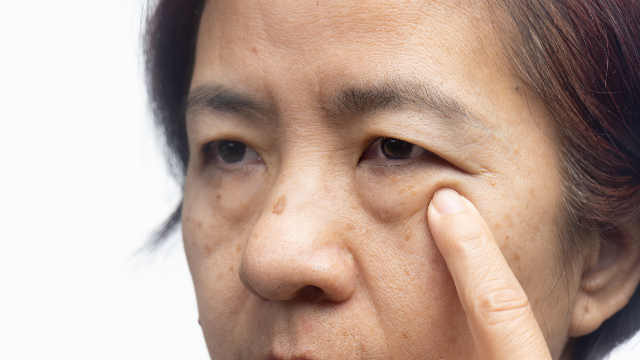
MedlinePlus reports that vision problems are often present with ptosis, beginning as a sense that the very top of the visual field is blocked, and that vision may be blocked completely when the lid covers the pupil. Cambridge University Hospitals, an NHS foundation trust, describes patients with more severe ptosis tilting the head back, overusing the forehead muscle, or lifting the eyelid with a finger in order to see clearly.
Moorfields adds that a low upper lid can also cause difficulty keeping the eyes open, eyestrain, eyebrow ache from the effort of raising the lid, and fatigue when reading.
Merry Plastic Surgery's own patient information reflects this dual nature. The clinic states that ptosis correction may suit patients whose upper eyelid droops and affects the appearance or, in some cases, the visual field, and that the appropriate treatment depends on the degree and cause of the drooping, the eyelid structure, and the patient's goals.
How Merry Plastic Surgery Assesses the Eyelid
Consultation at the clinic covers your concerns, expectations, eye-opening habits, and general eye-health history. The surgeon then assesses:
- Iris exposure, meaning how much of the colored part of the eye is visible
- Eyelid muscle strength
- Eyelid thickness
- Fat and muscle volume in the lid
Those measurements determine the severity of the ptosis and whether a non-incisional or incisional approach is appropriate. The clinic asks patients to disclose relevant eye-health and surgical history, specifically including dry eye, thyroid eye disease, previous eyelid surgery, and bleeding disorders.
Merry Plastic Surgery applies a concern-specific, anatomy-based approach across its Eye Surgery category rather than one standardized eyelid technique. Ptosis correction focuses on the eyelid-lifting muscle, double eyelid surgery on the crease, under-eye fat repositioning on fat position, canthoplasty on canthal shape, and revision surgery on scar tissue from earlier operations.
For comparison, Cambridge University Hospitals describes an NHS assessment that measures the degree of droop and how well the eyelid muscle works, and includes a visual field test to document whether vision is affected.
The Two Techniques Offered
Non-incisional correction. Small holes are made in the eyelid, the levator muscle is looped and fixed with fine sutures to shorten and lift it, and natural adhesion between skin and muscle helps form the eyelid crease. The clinic states this suits milder ptosis with thin eyelids and relatively little excess fat or muscle.
Incisional correction. The eyelid skin is opened, excess or sagging skin and unnecessary fat or muscle may be removed, the levator muscle is reinforced and sutured to the tarsal plate, and a double-eyelid line can be formed at the same time. The clinic states this suits moderate-to-severe ptosis, or thicker eyelids with greater fat or muscle volume.
Because the incisional technique can also create or refine a crease, a corrected lid height and a defined fold can often be addressed in one operation. Merry Plastic Surgery evaluates each patient before deciding whether combining procedures is suitable.
Anesthesia, Operating Time, and Discharge
Both techniques are typically performed under local or twilight (sleep) anesthesia. Hospitalization is generally not required, and patients return home the same day. The clinic lists an approximate operating time of around 30 minutes for the non-incisional technique and typically under one hour for the incisional technique.
Cleveland Clinic states that ptosis surgery is performed under local anesthesia with sedation, so the patient is awake but does not feel the procedure. Cambridge University Hospitals notes that operating under local anesthesia allows more careful adjustment of eyelid height during surgery, which supports a more predictable result.
Recovery, Sutures, and Follow-Up
Merry Plastic Surgery describes general recovery of approximately five to seven days. The non-incisional technique does not require suture removal. For the incisional technique, sutures are typically removed after roughly three to seven days. Follow-up is generally scheduled once or twice, and individual recovery varies with the procedure and the patient's condition.
NHS patient information fills in the wider healing curve. Cambridge University Hospitals reports that eyelid swelling usually lasts 10 to 14 days, with antibiotic ointment and lubricating drops typically prescribed for about two weeks. Guy's and St Thomas' NHS Foundation Trust advises avoiding strenuous activity, including swimming, for two weeks, and notes that vision may be blurred for a few days and contact lenses may not be wearable.
Because ptosis correction changes the position and function of the upper eyelid, Merry Plastic Surgery treats follow-up as an important part of the process, monitoring eyelid position, symmetry, and healing rather than judging the result too early, since swelling and temporary asymmetry can affect appearance during early healing.
Risks and Possible Complications
Temporary swelling, bruising, and mild discomfort are common during recovery. Merry Plastic Surgery lists eyelid asymmetry, under-correction, over-correction, and the potential need for adjustment among possible complications, and notes that suture-related irritation may occur with the incisional technique. The clinic asks patients to report persistent double vision, significant ongoing asymmetry, signs of infection, or difficulty fully closing the eyes.
Independent sources put numbers to the precision problem. Guy's and St Thomas' states that ptosis surgery is generally successful, with eight out of ten eyelids sitting in a good position afterward, and that under-correction or over-correction is possible and may require reassessment or further procedures. Cambridge University Hospitals reports a 10 to 20 percent chance of over-correction, in which the eyelid ends up too high, and explains that because the lid-raising muscle has been tightened, the eye may not close fully and can become dry, which lubricant drops and ointment usually manage.
Guy's and St Thomas' also lists bruising and swelling lasting a few weeks, wound infection that may need antibiotics, a gritty or dry sensation that can persist for months, and, very rarely, deep bleeding that can disturb vision and must be reported immediately.
What the Surgery Can and Cannot Deliver
Merry Plastic Surgery describes expected improvements as greater visible iris exposure, eyes that look larger and clearer, a more alert and less tired resting expression, and easier, more comfortable eye opening. Correcting the underlying muscle weakness may also reduce the habit of raising the eyebrow or forehead to compensate, and can help address eyelid asymmetry.
The clinic is explicit that results vary according to ptosis severity and individual eyelid anatomy and are not guaranteed. The eyelid-opening effect is intended to be durable because the procedure directly shortens or reinforces the opening muscles, but individual healing, muscle tone, aging, and other biological factors can affect the result over time, so a permanent or lifetime outcome cannot be promised.
Support for International Patients
Merry Plastic Surgery operates from Gangnam-gu in Seoul and is registered with Korea's Ministry of Health and Welfare as a medical institution for attracting foreign patients. An English-speaking team is available, online consultation is offered, and two dedicated international patient coordinators, Director Hyemi Jung and Director Yoonjin Park, assist foreign patients throughout their visit.
For eye surgery, the clinic provides pre-consultation guidance so international patients can describe their eyelid concerns and surgical history before traveling, plus post-treatment guidance after returning home. Merry Plastic Surgery does not publish a fixed Korea-stay requirement for ptosis correction, so discuss travel dates before booking flights and allow time for postoperative assessment.
You can review credentials on the Merry Plastic Surgery doctors page, including Dr. Jimin Lee's profile. Dr. Lee is a Plastic Surgery Specialist and Director at the clinic, trained at Kyung Hee University Medical Center, whose listed services include upper eyelid surgery and eyelid surgery (blepharoplasty). Dr. Lee is a full member of the Korean Society of Plastic and Reconstructive Surgeons, the Korean Society for Aesthetic Plastic Surgery, and the International Society of Aesthetic Plastic Surgery.
The Bottom Line
- Ptosis correction targets the eyelid-opening muscle itself, which is what separates it from double eyelid surgery and from removing excess lid skin.
- Merry Plastic Surgery offers a non-incisional technique for milder ptosis with thin lids and an incisional technique for moderate-to-severe ptosis or thicker lids.
- Both are typically done under local or sleep anesthesia without hospitalization, with general recovery of about five to seven days and one or two follow-up visits.
- Adult ptosis can restrict the upper visual field, so MedlinePlus advises an ophthalmologist review for new or rapidly changing drooping.
- Under-correction, over-correction, and asymmetry are recognized possibilities, and no specific eyelid height or lasting result can be guaranteed.
Frequently Asked Questions
How can I tell whether I have ptosis or just extra eyelid skin?
You often cannot tell without an examination, and MedlinePlus notes that both problems are commonly present at once. A surgeon measures where the lid margin sits, how much iris is exposed, and how strongly the lifting muscle works. Merry Plastic Surgery uses those findings to decide whether ptosis correction, an eyelid-skin procedure, or a combination is appropriate.
Should an eye doctor check my droopy eyelid before I consider surgery?
Yes, particularly if the change is recent or progressing. MedlinePlus advises seeing an ophthalmologist for new or rapidly changing eyelid drooping in adults, and Moorfields Eye Hospital lists nerve and muscle conditions among the less common causes. Merry Plastic Surgery asks patients to disclose existing eye symptoms, previous eye procedures, and medical conditions during consultation, because identifying the cause comes first.
Which technique is used for a thicker eyelid?
Merry Plastic Surgery states that incisional correction generally suits moderate-to-severe ptosis, or eyelids that are thicker with greater fat or muscle volume. The incisional approach allows removal of excess or sagging skin and unnecessary fat or muscle, and reinforcement of the levator muscle onto the tarsal plate. The non-incisional method is generally reserved for milder ptosis with thinner lids, and eyelid thickness is assessed directly at consultation.
When can I get back to normal activities?
Merry Plastic Surgery describes general recovery of about five to seven days, with incisional sutures removed after roughly three to seven days and no suture removal for the non-incisional technique. Guy's and St Thomas' NHS Foundation Trust advises avoiding strenuous activity, including swimming, for two weeks after ptosis surgery. Cambridge University Hospitals reports that eyelid swelling usually lasts 10 to 14 days, so your own timeline depends on the technique used and how you heal.
Can a double eyelid line be created during the same operation?
Yes, Merry Plastic Surgery states that a double-eyelid crease can be formed or refined during ptosis correction, particularly with the incisional technique. With the non-incisional method, natural adhesion between skin and muscle helps form a crease as part of the procedure. Whether combining the two goals suits you depends on your eyelid anatomy and preferences, and the clinic decides this during surgical planning.
What symptoms should I report during recovery?
Merry Plastic Surgery asks patients to report persistent double vision, significant ongoing asymmetry, signs of infection, or difficulty fully closing the eyes. Guy's and St Thomas' advises going to an eye department or emergency department immediately if the eye becomes more painful, vision worsens, redness increases, or there is excess discharge. Do not wait for a scheduled appointment if any of these appear, though early swelling and mild discomfort are expected.
Will the correction last for life?
Not necessarily. Merry Plastic Surgery states the eyelid-opening effect is intended to be durable because the surgery directly shortens or reinforces the opening muscles, but healing, muscle tone, aging, and other biological factors can change the result over time. Cambridge University Hospitals notes that late recurrence of the droop is possible and may require further surgery. A permanent or lifetime outcome should not be assumed.
This article is for general informational purposes and does not constitute individualized medical advice. Surgical candidacy, technique, and expected outcomes can only be determined through a consultation with a qualified surgeon. It is not a self-diagnosis tool.
More Articles
Continue reading our clinical guides.
Operating Room Standards: What You Can Ask and Verify
You will never inspect a sterilization room. What you can do is ask questions whose answers reveal whether a facility thinks about this systematically.
Learn More
Staying in Korea After Rhinoplasty: Why No Number Exists
The clinic publishes no fixed figure, and that is not an omission. A nose heals on a timetable long enough that any single number would be misleading.
Learn More

Bringing Someone With You: What a Companion Actually Does
Decide this by listing the hours a companion would actually cover, rather than by how you feel about going alone. Most are ordinary, and a few are not.
Learn More