Personalized Medical Care & Dedicated International Patient Concierge


Eye Surgery · Needs Clinic Confirmation
Double Eyelid Surgery
Double eyelid surgery is a procedure within eye plastic surgery designed to create or redefine the fold above the eye — the crease that separates the upper eyelid into two visible sections.
Schedule a ConsultationWhat is double eyelid surgery in eye plastic surgery?

Double eyelid surgery is a procedure within eye plastic surgery designed to create or redefine the fold above the eye — the crease that separates the upper eyelid into two visible sections. For patients without a natural fold, or with an uneven, shallow, or asymmetrical one, this surgery reshapes the eyelid architecture to produce a clearer, more balanced eye contour.
At Merry Plastic Surgery, the double eyelid line is not applied as a single fixed template. Consultation begins by identifying which of four fold types — in-fold, in-out line, semi-out line, or out-line — and which of four fold heights — no fold, hidden (subtle) fold, medium fold, or large fold — will look most natural on that individual's eyes. Because the starting point, end point, and height of the line all shape the final look differently, this classification step is what allows the result to read as personal rather than generic.
There are two surgical pathways used to build the fold:
Natural adhesion (non-incisional) technique. Fine sutures are passed through several tiny points on the eyelid, encouraging natural adhesion between the levator muscle and the overlying skin. No incision is made, so the resulting fold tends to sit shallower and softer, closely resembling a naturally occurring double eyelid.
Incisional technique. An incision is made along the designed eyelid line, through which excess skin, muscle, and fat are precisely removed and the eyelid structure is fixed at the desired height. This approach allows more thorough correction of heavier eyelids, more fat, or more pronounced asymmetry, producing a crisper, more clearly defined line.
Neither approach is presented as superior in every case — the choice depends on eyelid thickness, existing fat volume, skin elasticity, and the patient's aesthetic goal, and this is determined during consultation rather than assumed in advance.
Who needs double eyelid surgery treatment?
Double eyelid surgery may be worth discussing with a specialist if you recognize yourself in the following:
You want a double eyelid line that genuinely suits the shape of your own eyes, rather than a generic fold
You want your eyes to appear bigger and more open
Your eyes show noticeable asymmetry between the left and right side, disrupting overall facial balance
You have eyelid ptosis (drooping) or excess fat in the eyelid area that makes the eyes look heavy or tired
You want an eyelid line designed to minimize the likelihood of the fold loosening or fading over time
You've had a previous double eyelid procedure that didn't hold, and you're looking for a more secure result
This list is a general guide. Whether you are a suitable candidate — and which technique fits your eyelid anatomy — can only be confirmed through an in-person or virtual consultation with a plastic surgery specialist.
Meet the specialists in eye surgery
|
|
Dr. Sungtaek Hong | Dr. Jimin Lee |


Dr. Sungtaek Hong — Representative Director
Board-certified Plastic Surgeon (Korea University Medical Center) with surgical experience across eye surgery, rhinoplasty, facial contouring, and lifting procedures, bringing a broader facial-structure perspective to eyelid surgical planning. Dr. Hong is a member of the eye surgery-focused research group within the Korean Society of Plastic and Reconstructive Surgeons.
Dr. Jimin Lee — Director
Board-certified Plastic Surgeon (Kyung Hee University Medical Center) and full member of the Korean Society of Plastic and Reconstructive Surgeons, the Korean Society for Aesthetic Plastic Surgery, and the International Society of Aesthetic Plastic Surgery (ISAPS), among other professional societies.
Together, these specialists share a treatment philosophy centered on identifying the specific anatomical structure responsible for a patient's eyelid concern before proposing a surgical plan, aiming for results that appear natural and are appropriately matched to each patient's face.
Treatment areas & expected improvements
Eyelid fold shape (in-fold, in-out line, semi-out line, out-line): The fold's starting and ending points determine how open or elongated the eye appears. An in-fold sits closer to the inner corner for a softer look, while an out-line extends further for a more elongated, dramatic shape. Selecting the right shape for the patient's eye spacing and face shape is central to a natural-looking outcome.
Eyelid fold height (no fold, hidden fold, medium fold, large fold): Fold height affects how visible the double eyelid line is at rest and when the eyes are open. A hidden or medium fold tends to look subtle and is often preferred by patients seeking a natural, "born with it" appearance, while a larger fold creates a more pronounced, defined eye shape.
Eyelid asymmetry: Differences in fold height, shape, or position between the two eyes can be addressed by designing each eyelid individually rather than mirroring a single template, aiming for better left-right balance.
Excess eyelid fat and mild ptosis: Where heaviness in the upper eyelid or mild drooping is present, the incisional technique allows removal of excess fat and tissue alongside fold creation, which can result in a more open, less heavy-looking eye.
Expected improvements include a more defined eyelid crease, a more balanced appearance between both eyes, and eyes that read as more open and awake. Individual results vary depending on native eyelid anatomy, skin elasticity, healing response, and the technique selected, and no specific cosmetic outcome can be guaranteed in advance.
Treatment process & timeline
Natural adhesion (non-incisional) double eyelid surgery:
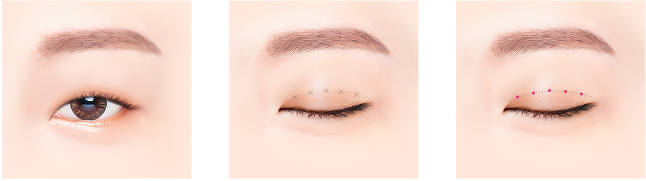
Consultation and baseline assessment — the surgeon evaluates the existing eyelid shape, skin thickness, and fat distribution.
Eyelid line design — the ideal fold height and shape are mapped out on the eyelid before any intervention.
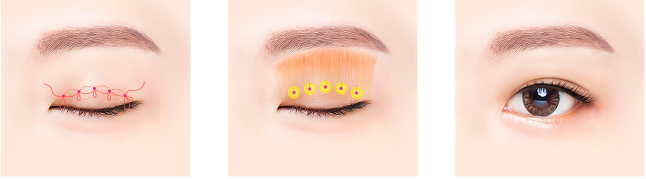
Micro-point marking — five fine points are marked along the designed line.
Suture placement — a fine, continuous thread is passed through these points to encourage firm adhesion between the skin and underlying muscle.
Adhesion induction — natural adhesion forms between the skin and muscle layer over the following days.
Immediate result — a natural-looking, non-deep eyelid line is visible without external incision.
Reported surgery time for this technique is within 30 minutes, performed under local or sleep anesthesia, with no suture removal required and a rapid return to daily activities.
Incisional double eyelid surgery:
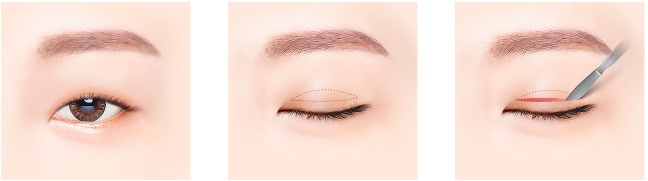
Consultation and diagnostic assessment — evaluation of skin excess, fat volume, and muscle tone.
Eyelid line design — the ideal fold height is mapped in line with facial proportions.
Incision — the eyelid is opened along the designed line.
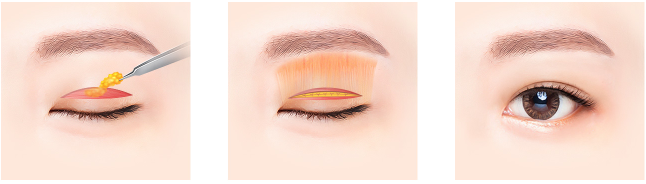
Muscle and fat reduction — excess muscle and fat are removed through the incision to reduce heaviness.
Line fixation and closure — the skin and levator muscle are precisely fixed at the intended height and sutured.
Recovery period begins — swelling gradually subsides to reveal a slimmer, well-defined line.
Reported surgery time for the incisional technique is within 1 hour, under local or sleep anesthesia. Hospitalization is not required for either technique. Suture removal for the incisional method is typically needed 5–7 days after surgery, with 1–2 follow-up visits and a general recovery period of around 5–7 days. These timeframes may vary depending on individual healing and the exact surgical method applied.
Results, safety & longevity
Both techniques are designed with fixation strength in mind — whether through the sutured adhesion method or through direct surgical fixation of the incisional method — with the aim of minimizing the probability of the eyelid fold loosening or fading over time. This is framed as a risk-reduction measure rather than a permanence guarantee, since long-term fold stability can still be influenced by individual skin elasticity, eyelid movement patterns, and healing.
The non-incisional method typically produces a shallower, softer fold consistent with a natural eyelid, with minimal downtime and no visible external scar, since no incision is made. The incisional method allows more thorough tissue correction for heavier eyelids or more visible fat, producing a crisper line, but involves a longer initial recovery window and a defined suture-removal step.
As with any eyelid procedure, temporary swelling, bruising, or mild discomfort in the days following surgery can be expected, and patients are advised to attend follow-up visits as scheduled so that healing can be monitored. Anyone considering double eyelid surgery should discuss their full medical history, any prior eyelid procedures, and their expectations candidly with the surgical team before proceeding.
Why choose Merry Plastic Surgery for double eyelid surgery?
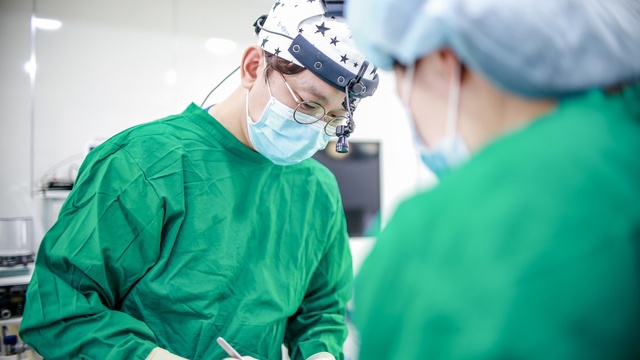
Merry Plastic Surgery approaches double eyelid surgery as a design problem before it is a surgical one. Rather than applying one standard fold to every patient, the eyelid line and fold shape are built around each person's existing eye shape and facial ratio, with the surgical technique chosen to support that specific design.
This individualized approach is paired with an emphasis on durability: regardless of whether the natural adhesion method or the incisional method is used, the fixation technique is applied with the specific aim of reducing the likelihood that the fold will loosen over time — an outcome many patients specifically ask about after a prior procedure elsewhere.
Personalized fold design matched to individual eye shape and facial proportion, rather than a single fixed template
Facial harmony as a design goal, so the resulting eyelid line is intended to sit naturally within the whole face rather than standing apart from it
Firm fixation protocols for both non-incisional and incisional techniques, aimed at minimizing fold loosening
Specialist-led planning, with input from surgeons holding dedicated eye plastic surgery study group membership within the Korean Society of Plastic and Reconstructive Surgeons
For patients considering treatment from outside the country, the same consultation-first approach applies: eyelid shape, fold type, and technique are discussed and agreed upon before any procedure is scheduled, so expectations are clear from the outset.
Real patient experiences
Patient A — seeking a natural, undefined-looking fold
A patient in their twenties with no natural eyelid fold wanted eyes that looked bigger without an obviously "done" appearance. After discussing eyelid shape and skin thickness, the non-incisional adhesion technique was used to create a soft, medium-height fold. Suggested image: before/after close-up of the eye area only, neutral lighting, no identifying features.
Patient B — addressing visible asymmetry
A patient with a noticeably higher fold on one eye than the other found it difficult to apply makeup evenly and felt self-conscious about the imbalance. Each eyelid was designed individually to bring both sides into closer alignment. Suggested image: split-screen comparison of both eyes, pre- and post-procedure, cropped to the eye region.
Patient C — heavy eyelids with excess fat
A patient with noticeably heavy upper eyelids and a tired-looking appearance opted for the incisional technique to remove excess fat and tissue alongside fold creation. Suggested image: front-facing eye-area photo showing the more open eyelid contour after healing.
Ready to design the eyelid line that suits you?
If you've been considering double eyelid surgery — whether you're looking for a soft, natural adhesion result or a more defined incisional outcome — the first step is a proper consultation, not a fixed decision. Merry Plastic Surgery's eye surgery team will assess your eyelid shape, skin, and fat distribution in person, walk you through which fold type and technique genuinely suit your eyes, and answer any questions about recovery, safety, or what to expect at each stage before you commit to anything.
[Primary CTA: Schedule your eyelid consultation with Merry Plastic Surgery]
For further questions before booking, you're welcome to reach out to our patient coordination team directly. We're glad to walk you through the process at your own pace, with no pressure to decide on the spot.
Other Services
Explore additional treatments offered by our specialists.

Eye Revision Surgery
Eye revision surgery is a corrective procedure for patients who have already undergone double eyelid surgery but are not satisfied with the outcome, or who have developed complications such as an irregular crease, asymmetry, or scarring.
Learn More

Breast Lift
A breast lift, known clinically as mastopexy, is a surgical procedure designed to correct breast sagging by repositioning breast tissue, removing excess skin where necessary, and restoring the nipple-areola complex to a more natural position on the breast.
Learn More
Double Eyelid Surgery
Double eyelid surgery is a procedure within eye plastic surgery designed to create or redefine the fold above the eye — the crease that separates the upper eyelid into two visible sections.
Learn More