Personalized Medical Care & Dedicated International Patient Concierge


Eye Surgery · Needs Clinic Confirmation
Ptosis (Droopy Eye) Correction
Ptosis correction at Merry Plastic Surgery adjusts the eyelid-opening muscles — the levator palpebrae superioris and, where needed, Müller's muscle — to increase the visible exposure of the iris and correct the drooping upper eyelid that creates a tired or sleepy appearance.
Schedule a ConsultationWhat Is Ptosis Correction in Eye Surgery?

Ptosis, sometimes described by patients as "sleepy eyes," occurs when the muscles responsible for opening the eye weaken and the upper eyelid drops lower than normal, covering more of the iris than it should. In a normal eye, the upper eyelid margin sits far enough above the pupil that roughly 5mm of the iris is exposed when the eye is fully open. In eyes affected by ptosis, that exposure can shrink to around 2mm or less, and when the eye is fully open the visible black portion of the iris may be less than 80% exposed.
This muscular weakness is mechanical, not cosmetic in origin. Two muscles are primarily responsible for lifting the upper eyelid: the levator palpebrae superioris, which provides the majority of eyelid elevation, and Müller's muscle, a smaller accessory muscle that fine-tunes eyelid position. When either muscle underperforms, the eyelid droops, and many people unconsciously compensate by raising their eyebrows or wrinkling their forehead just to open their eyes at a normal width — a habit that can, over time, contribute to forehead lines.
Ptosis correction surgery works by shortening or reinforcing these eyelid-opening muscles so the eyelid margin sits at a more typical height. This is achieved either through:
Non-incisional correction, where the levator muscle is shortened and fixed to the tarsal plate through small holes in the eyelid, without a full incision, or
Incisional correction, where the eyelid skin is opened to directly access and adjust the muscle, along with removal of excess or sagging tissue.
Because the surgical goal is to rebalance muscle function rather than simply remove skin, ptosis correction is often approached differently from standard double-eyelid surgery, even though a double-eyelid crease may be formed or refined as part of the same procedure.
Who Needs Ptosis Correction Treatment?
Ptosis correction may be worth discussing with a specialist if you recognize any of the following:
You want naturally bigger, clearer-looking eyes rather than a dramatically altered eye shape
Your eyes feel heavy, stuffy, or consistently look sleepy or tired to others, even when well-rested
You find yourself raising your eyebrows or lifting your forehead just to open your eyes fully
You've previously had double-eyelid surgery, but an underlying eyelid-opening weakness (ptosis) was never addressed
You are looking for a more fundamental, muscle-level correction of eyelid drooping rather than a purely surface-level adjustment
Friends, family, or even photographs consistently make you look more tired or less alert than you feel
You notice asymmetry between your two eyes when they are fully open
You've developed forehead tension or wrinkles from habitually compensating for weak eye-opening strength
A consultation and physical assessment of eyelid function and iris exposure is the only reliable way to confirm whether ptosis is present and, if so, how significant the correction needs to be.
Meet the Specialists in Eye Surgery
|
|
Dr. Sungtaek Hong | Dr. Jimin Lee |

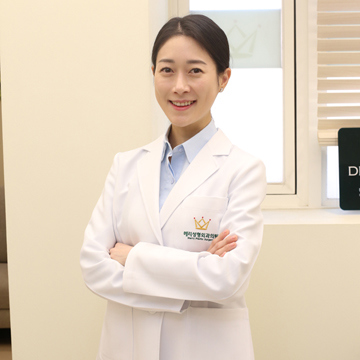
Dr. Sungtaek Hong — Representative Director
Board-certified Plastic Surgeon (Korea University Medical Center) with surgical experience across eye surgery, rhinoplasty, facial contouring, and lifting procedures, bringing a broader facial-structure perspective to eyelid surgical planning. Dr. Hong is a member of the eye surgery-focused research group within the Korean Society of Plastic and Reconstructive Surgeons.
Dr. Jimin Lee — Director
Board-certified Plastic Surgeon (Kyung Hee University Medical Center) and full member of the Korean Society of Plastic and Reconstructive Surgeons, the Korean Society for Aesthetic Plastic Surgery, and the International Society of Aesthetic Plastic Surgery (ISAPS), among other professional societies.
Together, these specialists share a treatment philosophy centered on identifying the specific anatomical structure responsible for a patient's eyelid concern before proposing a surgical plan, aiming for results that appear natural and are appropriately matched to each patient's face.
Treatment Areas & Expected Improvements
Upper Eyelid Muscle Function (Levator Palpebrae Superioris and Müller's Muscle): These are the two muscles responsible for lifting the upper eyelid. When they are weakened, the eyelid sits lower than it should and covers more of the iris than is typical. Ptosis correction directly addresses this by shortening and re-fixing the levator muscle, and adjusting Müller's muscle where indicated, to restore more typical eyelid height and opening strength.
Iris (Black Pupil) Exposure: In eyes affected by ptosis, exposure of the iris from the eyelid margin can be limited to roughly 1–2mm, versus approximately 5mm in an eye without ptosis. Correcting the eyelid-opening muscles increases this exposure, which is the primary driver of the "bigger, clearer eyes" effect patients typically notice.
Eyelid Crease and Skin (Incisional Technique): For patients undergoing the incisional approach, sagging or excess eyelid skin, along with unnecessary fat or muscle tissue, is addressed at the same time as the muscle correction, and a double-eyelid line can be formed or refined as part of the same procedure.
Forehead and Eyebrow Position: Because many patients with ptosis unconsciously raise their eyebrows or forehead to compensate for weak eye-opening strength, correcting the underlying muscle weakness can reduce the habitual need for this compensation.
Expected improvements include a larger appearance of visible iris, a more alert and less tired resting expression, and more comfortable, effortless eye-opening. The degree of improvement varies by individual based on the severity of ptosis, eyelid thickness, and the amount of existing fat, muscle, and skin laxity — results are not guaranteed and should be discussed individually during consultation.
Treatment Process & Timeline
Consultation — A discussion of your concerns, expectations, and eye-opening habits, along with a review of your general eye health history.
Diagnostic Assessment — Measurement of iris exposure and eyelid muscle strength to determine the degree of ptosis and whether a non-incisional or incisional approach is more appropriate for your eyelid thickness and fat/muscle volume.
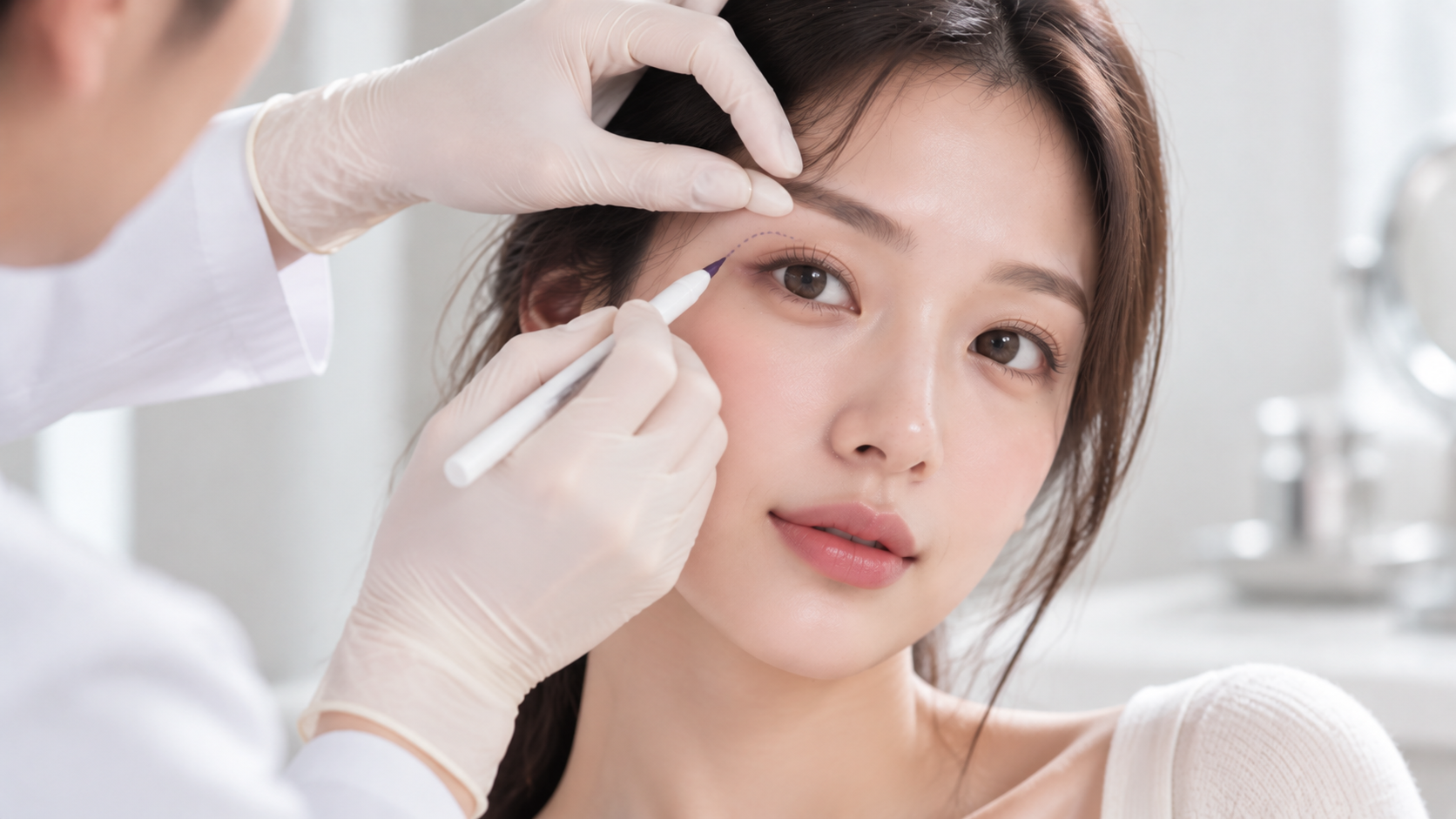
Design — Customized eyelid marking based on your facial proportions and the recommended surgical technique.
Procedure —
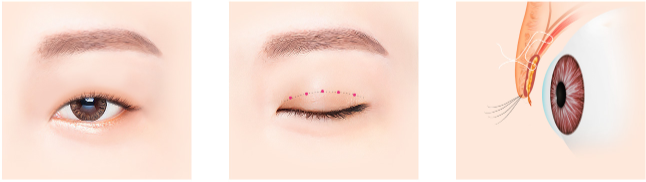
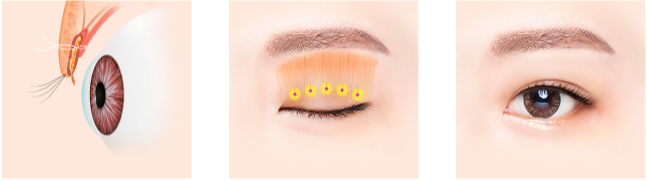
- Non-incisional technique: Small holes are made through the eyelid rather than a full incision. The levator muscle is looped and fixed with fine sutures tied in sequence, shortening the muscle and lifting the eyelid, while natural adhesion between skin and muscle is encouraged to help form the eyelid crease line. This approach typically takes about 30 minutes and is generally suited to milder ptosis in eyelids that are thin with relatively little excess fat or muscle.
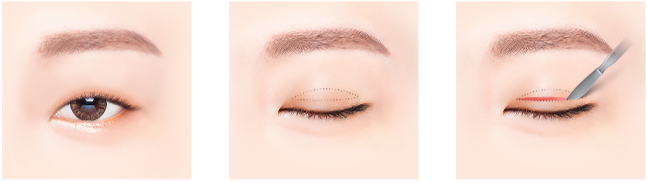
- Incisional technique: The eyelid skin is incised according to the surgical design. Sagging skin, along with excess fat and muscle, is removed. Muscle strength is checked and the levator muscle is sutured to the tarsal plate to reinforce eye-opening strength, and the double-eyelid line is formed at the same time. This approach typically takes under 1 hour and is generally suited to moderate-to-severe ptosis or thicker eyelids with more fat or muscle volume.
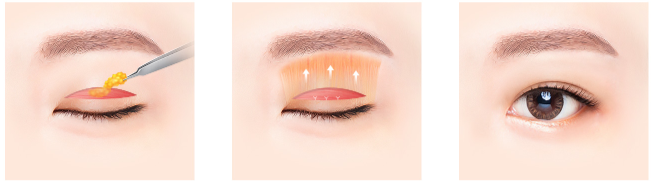
Immediate Aftercare — Both techniques are typically performed under local or twilight (sleep) anesthesia, do not require hospitalization, and allow the patient to return home the same day.
Follow-Up Timeline — Suture removal is not required after the non-incisional technique; for the incisional technique, sutures are typically removed after roughly 3–7 days. One to two follow-up visits are generally scheduled, with a general recovery period of around 5–7 days. Individual timelines can vary based on your condition and the specific technique used.
Results, Safety & Longevity
Biological rationale: Ptosis correction works by physically shortening or reinforcing the eyelid-opening muscles (levator palpebrae superioris and, where relevant, Müller's muscle) and fixing them more securely to the tarsal plate. Because the correction addresses the muscle mechanism directly, rather than only the overlying skin, the eyelid-opening effect is intended to be durable — though, as with any procedure involving living tissue, individual healing, muscle tone, and aging can influence results over time. No permanent or lifetime outcome is guaranteed.
Safety approach: Technique selection (non-incisional versus incisional) is based on an individualized assessment of ptosis severity and eyelid tissue characteristics, rather than a one-size-fits-all approach. Both techniques are designed to preserve natural eyelid movement and expression rather than creating an overly wide or artificial "surprised" look.
Side effects and risk transparency: As with any eyelid procedure, temporary swelling, bruising, and mild discomfort during the initial recovery period are common. Eyelid asymmetry, under- or over-correction, or a need for touch-up adjustment are recognized possibilities with any ptosis surgery and should be discussed candidly during consultation. Suture-related irritation can occur with the incisional technique prior to suture removal. Patients should disclose any history of dry eye, thyroid eye disease, prior eyelid surgery, or bleeding disorders during the diagnostic assessment.
When to seek medical consultation: Persistent double vision, significant asymmetry that does not improve as swelling resolves, signs of infection (increasing redness, warmth, or discharge), or difficulty closing the eye fully after surgery should prompt a follow-up visit with your surgical team.
Why Choose Merry Plastic Surgery for Ptosis Correction?

Ptosis correction is a procedure where the difference between a natural, well-rested result and an overdone or asymmetrical one often comes down to precise muscle-level diagnosis. Merry Plastic Surgery approaches ptosis correction with differentiated technical know-how aimed at giving each patient the ideal outcome suited to their own eyelid anatomy, rather than applying a single standardized technique to every case.
Because two distinct muscles — the levator palpebrae superioris and Müller's muscle — govern how the eye opens, and because eyelid thickness, existing fat, and muscle volume differ from person to person, the surgical team evaluates each of these factors individually before recommending a non-incisional or incisional approach. This distinction matters clinically: a technique suited to a thin eyelid with mild ptosis is not the same one that will safely and effectively correct a thicker eyelid with moderate-to-severe ptosis.
What sets treatment at Merry Plastic Surgery apart:
Increased iris exposure for genuinely clearer eyes — By directly correcting the muscles responsible for eyelid position, more of the iris becomes visible, changing the eye's overall impression without altering its natural shape.
Reinforced eye-opening strength for everyday comfort — Strengthening the levator muscle is intended to let patients open their eyes without habitually raising their eyebrows or forehead, supporting a more relaxed expression and potentially reducing compensatory forehead tension.
Tailored correction across a range of ptosis severity — From mild ptosis suited to the non-incisional approach to moderate or more advanced ptosis requiring incisional correction, treatment planning is adapted to the specific degree of drooping present.
Surgical oversight from an eyelid-focused specialist — Dr. Sungtaek Hong's membership in the Eye Plastic Surgery Study Group of the Korean Society of Plastic and Reconstructive Surgeons reflects a specific clinical focus on eyelid and periocular procedures, in addition to his broader plastic surgery training and academic role as Adjunct Professor at Korea University Medical Center.
For patients evaluating treatment options from outside the immediate area, consultations can be structured around your travel timeline, and the relatively short procedure time, lack of required hospitalization, and defined follow-up schedule (typically one to two visits) are worth discussing with the clinical team when planning your visit.
Real Patient Experiences
Patient A — Non-Incisional Correction
Suggested image: Before-and-after close-up of the upper eyelid area, neutral expression, eyes fully open. This patient had thin eyelids with relatively little excess fat, along with mild ptosis where the iris was only partially visible even with eyes fully open. Using the non-incisional technique, eyelid-opening muscle function was adjusted through small holes without a full incision. The patient reported that her eyes appeared more open and that she no longer felt the need to raise her eyebrows to see comfortably.
Patient B — Incisional Correction
Suggested image: Before-and-after close-up of the upper eyelid area, eyes fully open, natural lighting. This patient had thicker eyelids with more excess skin and fat, along with moderate ptosis and a habit of lifting his forehead throughout the day. The incisional technique was used to remove excess tissue, reinforce the levator muscle, and form a natural-looking eyelid crease in the same procedure. Following recovery, his eyes appeared noticeably more open at rest, and he described feeling less habitual tension across his forehead.
Individual results vary based on the degree of ptosis, eyelid anatomy, and healing. These examples describe typical outcomes and are not a guarantee of specific results for any individual patient.
Ready to Open Your Eyes to a More Refreshed, Alert You?
If you've noticed that your eyes look tired even when you're not, that you catch yourself raising your eyebrows just to see comfortably, or that a previous double-eyelid procedure never quite resolved a sense of heaviness in your upper lids, it may be worth having your eyelid function properly assessed. A personalized consultation with the ptosis correction team at Merry Plastic Surgery can help determine whether your case is best suited to a non-incisional or incisional approach, based on your eyelid thickness, muscle strength, and the degree of ptosis present — with realistic expectations discussed every step of the way.
Contact Merry Plastic Surgery today to schedule your ptosis evaluation and discuss which correction technique may be right for you.
Other Services
Explore additional treatments offered by our specialists.

Eye Revision Surgery
Eye revision surgery is a corrective procedure for patients who have already undergone double eyelid surgery but are not satisfied with the outcome, or who have developed complications such as an irregular crease, asymmetry, or scarring.
Learn More

Breast Lift
A breast lift, known clinically as mastopexy, is a surgical procedure designed to correct breast sagging by repositioning breast tissue, removing excess skin where necessary, and restoring the nipple-areola complex to a more natural position on the breast.
Learn More
Double Eyelid Surgery
Double eyelid surgery is a procedure within eye plastic surgery designed to create or redefine the fold above the eye — the crease that separates the upper eyelid into two visible sections.
Learn More