Personalized Medical Care & Dedicated International Patient Concierge


Eye Surgery · Needs Clinic Confirmation
Under-Eye Fat Repositioning
Under-eye fat exists naturally around the eyeball to help cushion it from impact.
Schedule a ConsultationWhat is under-eye fat repositioning in eye surgery?

Under-eye fat exists naturally around the eyeball to help cushion it from impact. In many people, this fat begins to protrude excessively beneath the eyes for one of two reasons: some individuals are congenitally without the bony support that would otherwise contain the fat in place, while in others, the fat pocket's supporting structure gradually weakens over time, allowing fat to push forward and downward.
Under-eye fat repositioning is built around addressing this from both directions at once. Rather than simply removing the protruding fat, the procedure releases any adhesions in the hollow tear trough area, then moves the excess fat through the conjunctival incision into that same hollow space — repositioning it, removing it where appropriate, and then reinforcing the orbital septum to fix the fat in its new position. This combined approach is intended to:
Correct the bulging, protruding appearance beneath the eyes
Fill in the sunken, shadowed tear trough using the patient's own repositioned tissue
Reinforce the septum to help minimize the possibility of the fat re-protruding
Because the entire procedure is performed through an internal conjunctival incision rather than through the skin, no external scar is left behind, which is intended to reduce recovery burden and support a natural-looking, bright, and vibrant eye impression.
Understanding under-eye fat protrusion: causes and age-related patterns
Under-eye fat protrusion tends to develop for one of two underlying reasons. In some patients, the bony structure that would normally hold fat in place around the eye socket is congenitally absent or underdeveloped, allowing under-eye fat to protrude downward from a young age. In others, the fat pocket's supporting membrane gradually loses strength over time, and the fat begins to protrude as this support weakens.
How this tends to present at different ages:
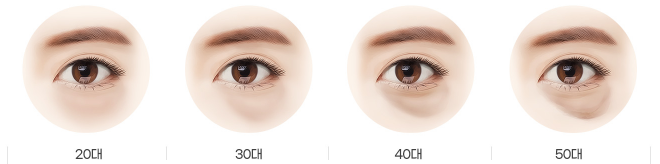
20s: Orbital fat protrudes, creating a bulging appearance beneath the eyes.
30s: Orbital fat protrusion gradually increases, and the tear trough begins to appear sunken by comparison.
40s: Orbital fat sags further and the tear trough becomes more clearly defined and pronounced.
50s: Skin over the tear trough thins, contributing to a more severely tired appearance overall.
Understanding the different types of dark circles
Not all dark circles stem from the same cause, and understanding which type is present helps determine the most appropriate treatment path:
Pigmentation type — Occurs when fine blood vessels beneath the eyes are more developed, or when the skin tone in that area is naturally darker. This type is generally addressed with laser treatment rather than surgery.
Under-eye hollowing type — Occurs when the tear trough area becomes sunken, often becoming darker and more visible with age. This type may be improved using filler or fat grafting to add volume, or through under-eye fat repositioning.
Fat protrusion type — Occurs when protruding under-eye fat casts a shadow, making the area beneath it appear to sag. This type is typically addressed through surgical approaches such as under-eye fat removal or under-eye fat repositioning.
Because dark circles can result from pigmentation, hollowing, fat protrusion, or a combination of these, an accurate diagnosis during consultation is an important first step before deciding on a treatment path.
Who needs under-eye fat repositioning treatment?
Under-eye fat repositioning may be worth discussing with a specialist if you recognize any of the following:
You want to improve both under-eye fat protrusion and tear trough hollowing at the same time
You want a vibrant, bright, and youthful-looking eye impression
Your impression looks dull or dark specifically because of tear trough hollowing
You have bulging under-eye fat and dark circles occurring together
Your under-eye fat is giving you an aged appearance
You've noticed your under-eye area changing across your 20s, 30s, or 40s as described above
You are looking for a correction with no visible external scarring
You want to preserve the natural fullness just beneath your eye (aegyo-sal) rather than a flattened, over-corrected look
A consultation with one of our eye surgery specialists will help determine which type of dark circle or protrusion pattern applies to you, and whether under-eye fat repositioning or an alternative approach — such as laser treatment, filler, or fat grafting — is more suitable for your anatomy.
Meet the specialists in eye surgery
|
|
Dr. Sungtaek Hong | Dr. Jimin Lee |


Dr. Sungtaek Hong — Representative Director
Board-certified Plastic Surgeon (Korea University Medical Center) with surgical experience across eye surgery, rhinoplasty, facial contouring, and lifting procedures, bringing a broader facial-structure perspective to eyelid surgical planning. Dr. Hong is a member of the eye surgery-focused research group within the Korean Society of Plastic and Reconstructive Surgeons.
Dr. Jimin Lee — Director
Board-certified Plastic Surgeon (Kyung Hee University Medical Center) and full member of the Korean Society of Plastic and Reconstructive Surgeons, the Korean Society for Aesthetic Plastic Surgery, and the International Society of Aesthetic Plastic Surgery (ISAPS), among other professional societies.
Together, these specialists share a treatment philosophy centered on identifying the specific anatomical structure responsible for a patient's eyelid concern before proposing a surgical plan, aiming for results that appear natural and are appropriately matched to each patient's face.
Treatment areas & expected improvements
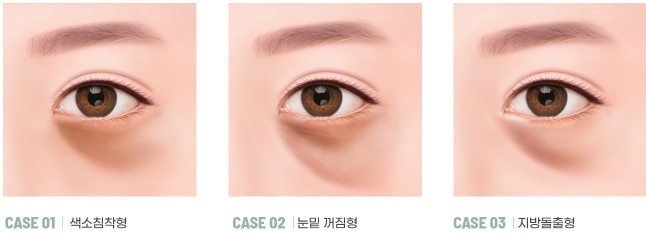
Protruding orbital fat (under-eye bulge): This is fat that has pushed forward past its normal boundary, creating a visible bulge along the lower eyelid. It may be present from a young age due to congenital bony structure, or it may develop gradually as supporting tissue weakens with time. Repositioning this fat, rather than discarding it outright, allows it to be put to functional use in the hollow area nearby.
Tear trough hollowing and adhesion: The tear trough is the groove running from the inner corner of the eye down toward the cheek. As fat protrudes above it, the area itself can become increasingly sunken, sometimes with adhesions that keep it fixed in a hollow position. Releasing these adhesions and filling the space with repositioned fat is intended to soften the transition between the lower eyelid and cheek.
Fat-protrusion-type dark circles: Dark circles caused by fat protrusion occur because the bulge itself casts a shadow onto the skin below it. Addressing the fat's position directly targets this shadow, distinct from dark circles caused by pigmentation or skin thinning alone.
Orbital septum integrity: Because a weakened septum often underlies fat protrusion, reinforcing and fixing it during the procedure is intended to help support the correction over time and to help minimize the possibility of fat re-protruding in the same way.
Expected improvements include a smoother, less bulging under-eye contour, a softened tear trough, and a brighter, more vibrant, youthful-looking eye impression. As with any surgical procedure, the degree of improvement varies according to individual anatomy, skin quality, age, and the extent of fat protrusion or hollowing present before surgery, and results should not be understood as guaranteed or identical across patients.
Treatment process & timeline
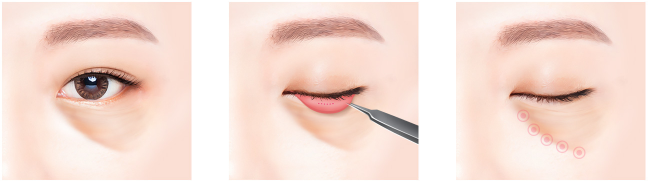
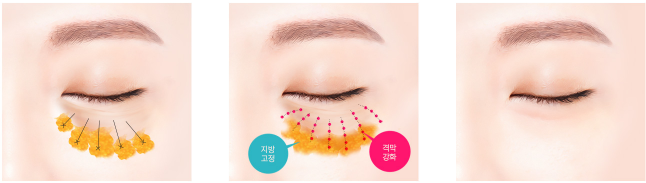
Consultation — Your surgeon evaluates your under-eye area to determine whether your dark circles or bulging stem from pigmentation, hollowing, fat protrusion, or a combination, since each type calls for a different approach.
Diagnostic assessment — The degree of fat protrusion, tear trough depth, and any adhesion in the sunken area is assessed to plan how much repositioning versus removal is appropriate.
Preparation and anesthesia — The procedure is performed under local or sleep (IV sedation) anesthesia, with surgery itself typically taking around one hour.
Conjunctival incision and adhesion release — A precise incision is made inside the conjunctiva, and any adhesions in the sunken tear trough area are released to prepare it to receive the repositioned fat.
Fat repositioning and septal reinforcement — The protruding fat is moved into the released tear trough area, after which the orbital septum is reinforced and the fat is fixed in place to help support a stable correction and reduce recurrence risk.
Aftercare and follow-up — Hospitalization is not required, and stitch removal is not necessary since the incision is internal. Patients typically return for 1 to 2 follow-up visits, with recovery generally taking about one week. Actual timelines can vary depending on individual healing and the extent of correction performed.
Results, safety & longevity
Under-eye fat repositioning is designed to address the structural cause of protrusion rather than the visible fat alone. By releasing adhesions, repositioning fat into the hollow tear trough, and reinforcing the orbital septum, the procedure aims to correct bulging and hollowing together while helping to minimize the likelihood of fat re-protruding over time. That said, no surgical result can be guaranteed to be permanent, and outcomes depend on each patient's individual tissue characteristics and ongoing aging process.
Because the incision is made through the conjunctiva rather than the skin, there is no external scarring, and swelling is generally expected to be more limited and to resolve over the course of about one week, consistent with the described recovery timeline. As with any surgical procedure, temporary swelling, bruising, or mild discomfort in the days following surgery is common, and individual recovery experiences vary. Suitability for this specific technique — including whether fat repositioning, removal, or a combination is most appropriate — is determined on a case-by-case basis during consultation. Anyone experiencing unusual pain, vision changes, or prolonged swelling after surgery should contact their surgical team promptly.
Why choose Merry Plastic Surgery for under-eye fat repositioning?

Merry Plastic Surgery approaches under-eye fat repositioning with differentiated know-how and technical skill aimed at delivering an ideal, natural result suited to each patient — rather than treating protrusion and hollowing as two separate problems to be solved independently. The transconjunctival technique used at Merry is central to this: operating entirely from inside the eyelid allows for meaningful structural correction of both the bulge and the tear trough, while leaving no visible external scar.
The practice also places specific emphasis on preserving the natural fullness just beneath the eye — often called aegyo-sal — so that the result reads as a naturally youthful, vibrant eye rather than an overly hollow or surgical one. Septal reinforcement is built into the standard procedure, reflecting an intentional focus on reducing the likelihood of recurrence rather than offering a purely cosmetic, temporary correction.
Transconjunctival incision with no visible external scarring
Tear trough adhesion release combined with fat repositioning to correct bulging and hollowing together
Septal reinforcement and fixation aimed at minimizing recurrence
Technique designed to preserve natural aegyo-sal fullness for a youthful, vibrant look
For patients coordinating travel around their procedure, the treatment path is structured around a limited number of follow-up visits (1 to 2) and no required hospitalization, making the overall timeline easier to plan around.
Real patient experiences
Case A — Early protrusion in the 20s
A patient in her twenties came in concerned about a persistently bulging under-eye look that made her appear tired even when well-rested. After evaluation, her under-eye fat protrusion was addressed through repositioning, and she reported a smoother, less bulging contour during her follow-up visits.
Suggested image: close-up before-and-after of the lower eyelid area, taken at consultation and at the one-week follow-up.
Case B — Combined protrusion and tear trough hollowing in the 30s
A patient in her thirties presented with both under-eye fat protrusion and a noticeably sunken, shadowed tear trough. Following adhesion release, fat repositioning, and septal reinforcement, she noted a brighter, more even under-eye area at follow-up.
Suggested image: three-quarter facial photo highlighting the under-eye and cheek transition, before and after.
Case C — Pronounced dark circles in the 40s
A patient in her forties sought correction for dark circles that had become more pronounced as her tear trough deepened and her under-eye fat sagged further. After her procedure, she described her under-eye area as looking more rested and less shadowed in daily lighting.
Suggested image: close-up under-eye comparison under natural daylight, pre-op and post-recovery.
Ready to say goodbye to dark, bulging under-eyes?
If bulging under-eye fat, a hollow tear trough, or persistent dark circles have been giving you a tired or aged impression, our eye surgery specialists at Merry Plastic Surgery are ready to help you understand your options clearly. During a personal consultation, your surgeon will identify which type of dark circle or protrusion pattern applies to you, explain whether fat repositioning, removal, or another approach best suits your anatomy, and walk you through the full recovery timeline and realistic expectations before you make any decision.
Contact Merry Plastic Surgery today to schedule your consultation, or reach out through our patient coordination team for guidance on scheduling and travel planning. We're here to answer your questions at every step, with no pressure and no rushed decisions.
Other Services
Explore additional treatments offered by our specialists.

Eye Revision Surgery
Eye revision surgery is a corrective procedure for patients who have already undergone double eyelid surgery but are not satisfied with the outcome, or who have developed complications such as an irregular crease, asymmetry, or scarring.
Learn More

Breast Lift
A breast lift, known clinically as mastopexy, is a surgical procedure designed to correct breast sagging by repositioning breast tissue, removing excess skin where necessary, and restoring the nipple-areola complex to a more natural position on the breast.
Learn More
Double Eyelid Surgery
Double eyelid surgery is a procedure within eye plastic surgery designed to create or redefine the fold above the eye — the crease that separates the upper eyelid into two visible sections.
Learn More